The fuel-saving formula
Gross saving in pounds = price difference in pence per litre × litres bought ÷ 100.
Extra fuel cost (£) = extra miles ÷ UK MPG × 4.54609 × fuel price in pence per litre ÷ 100.
Saving after extra driving = gross saving − extra fuel cost.
The factor 4.54609 converts UK imperial gallons to litres. Use UK MPG, not US MPG. Extra miles means the difference between the journey with the fuel stop and the journey without it; do not double a distance that already includes leaving and rejoining your route.
The same illustrative 40p-per-litre difference saves £28.00 on a 70-litre fill but only £4.00 on a 10-litre top-up, before extra driving. Use the amount you actually expect to buy.
Example: £28.00 at the pump becomes £22.70 after driving
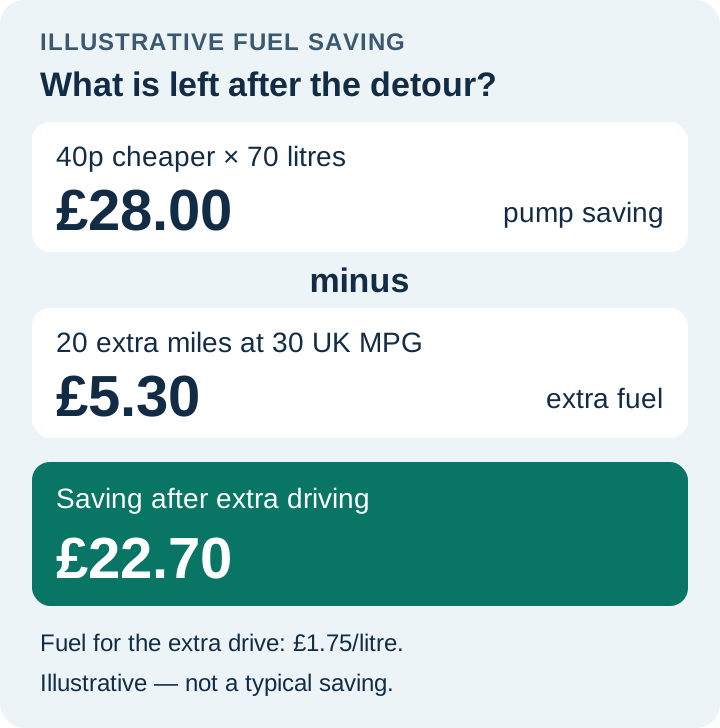
For an illustrative larger fill-up—not a typical or guaranteed saving, compare a station at 215p per litre with one at 175p. You plan to buy 70 litres, so the price difference is 40p per litre. These are example prices, not current station prices.
The pump-price saving is 40p × 70 litres ÷ 100 = £28.00. If the cheaper station adds 20 miles in total and your car returns 30 UK MPG, the extra drive uses about 3.03 litres. At £1.75 per litre, that costs about £5.30: 20 ÷ 30 × 4.54609 × £1.75. The estimated saving after extra driving is therefore £28.00 − £5.30 = £22.70.
For a 10-litre top-up at the same prices, the pump saving is only £4.00. After the same £5.30 extra-fuel cost, you would be about £1.30 worse off. A larger price difference does not make every detour worthwhile.
That result may be worthwhile if the stop is convenient. If the same detour is slow, stressful or only saves 30p after fuel, most drivers would reasonably ignore it.
Why your vehicle matters
Two drivers can see different estimated savings for the same station. A vehicle with different MPG, fuel type or tank size can change whether the stop is worthwhile.
Efficient-driving guidance from the Vehicle Certification Agency and Energy Saving Trust is relevant here because the detour is not just a distance. Harsh acceleration, braking, excessive speed and under-inflated tyres can all worsen real fuel consumption. The same station can therefore be a better deal on a smooth route than on a stop-start route.
What numbers should you use?
- Litres: use the expected fill amount, not always a full tank. A small top-up rarely justifies a long detour.
- MPG: use a realistic recent MPG from your car, not only the best number you have ever seen.
- Distance: use the additional road miles compared with the journey without the fuel stop, not the straight-line distance to the station.
- Fuel price: use the current station price and check when the price last changed before buying.
- Time: decide your own threshold. Fuel maths can show the cash result, but it cannot decide what ten extra minutes is worth to you.
A quick decision rule
Set a threshold that suits you. As an illustration, a pump-price saving below £1 may only justify a stop already on your route, while £3–£5 may make a short detour worth calculating. These are examples, not fixed rules: subtract the extra fuel cost and consider your time.
A positive result means the price saving exceeds the estimated detour fuel cost under your inputs. It does not include every possible cost or decide whether the extra time is worthwhile.
Try a real journey in the free fuel route planner. Compare listed station prices using your MPG, fill amount and extra road miles. Keep any value you assign to time separate.
Calculate your own example
Enter your prices, expected litres and fuel economy in the journey cost calculator. For an explanation of the comparison prices used by Route & Fuel, read how savings are calculated.
Keep fuel savings separate from any value you assign to your time, parking charges or other costs. That makes the result easier to compare and check.