On this page
How much more does RON 99 cost?
RON 99 average: 193.7p per litre. E10 average: 174.5p per litre. Price difference: 19.20p a litre.
These averages use the station records included in Route & Fuel's comparison. They are not the official government national series or a quote for your local station. Check the price-data date above and compare the actual stations you can use.
Scroll sideways to see all columns. Keyboard: use the left and right arrow keys.
| Fuel added | Added cost compared with E10 |
|---|---|
| 30 litres | £5.76 |
| 45 litres | £8.64 |
| 55 litres | £10.56 |
The rows show how the price difference changes with the amount you buy. Enter your expected litres in the calculator for your own comparison.
MPG improvement required to offset the higher fuel price: 11.0%.
This is how much further each gallon would need to take you to keep fuel cost per mile unchanged. It is not a predicted MPG benefit. Without both average prices, a reliable required percentage is unavailable. Detour costs are excluded.
How to calculate the MPG you would need
Required MPG = your usual MPG × premium price per litre ÷ regular price per litre. Use the same price units on both sides. When premium costs more, the percentage increase in MPG required equals its percentage price premium.
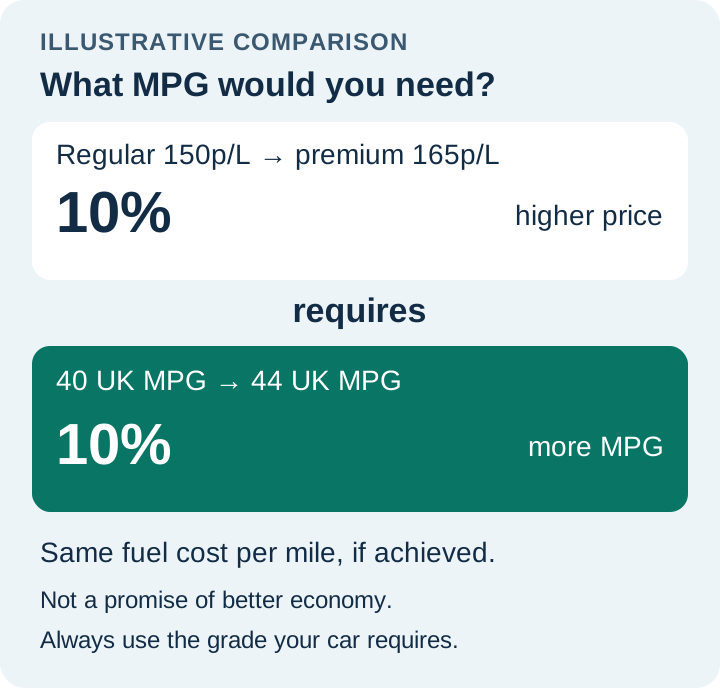
For an illustrative regular price of 150p and premium price of 165p, the premium is 10%. A car normally returning 40 UK MPG would need 44 UK MPG on premium just to match its fuel cost per mile. Those are example inputs, not current station prices or an expected improvement. Only compare fuels permitted by your vehicle manufacturer or tuner.
RON 99 and E10 average prices
The lines show averages from Route & Fuel's included station records, not a forecast or a guarantee that a particular station stocks RON 99.
What does a higher octane rating change?
RON measures a petrol fuel's resistance to engine knock. Some turbocharged or high compression engines can make use of higher octane fuel through their ignition timing or boost control, but the benefit depends on the engine and its software. Research from NREL and SAE shows that the response varies by engine design, load and calibration.
Is RON 99 worth it for a performance car?
If the manufacturer requires 98 or RON 99, use that grade. If premium petrol is recommended for full performance but 95 RON is also permitted, RON 99 may help the engine deliver the response it was designed for under heavier load.
Check the fuel flap, the owner's manual or the manufacturer's guidance. If 95 RON is the only grade specified, do not assume RON 99 will reduce your fuel bill.
What about remapped or tuned cars?
Use the octane grade specified by the tuner for the ECU map installed on the car. A remap can be calibrated for a particular fuel grade, so the factory recommendation may no longer describe the software you are running.
APR, for example, tells drivers not to use a lower octane than the tune requires. Other tuners offer separate maps or modes for different fuel grades. Follow the instructions for your own map and ask the tuner to confirm the fuel requirement.
Which UK fuels appear in the RON 99 search?
The table shows Route & Fuel's current search groups. Texaco sells Supreme 99 Performance+, a 99 RON E5 petrol, at selected stations. It remains in the Other E5 search because the premium grade varies by location. Confirm the product available at your chosen station.
Scroll sideways to see all columns. Keyboard: use the left and right arrow keys.
| Retailer and fuel | Search group |
|---|---|
| Shell V-Power Unleaded | RON 99 |
| Tesco Momentum 99 | RON 99 |
| Esso Synergy Supreme+ 99 | RON 99 |
| Texaco premium petrol, including Supreme 99 Performance+ where available | Other E5 |
How can you compare RON 99 fairly?
- Confirm the grade required by the manufacturer or ECU tuner.
- Use the same fuel grade for several tanks rather than judging one short trip.
- Record the litres added and miles driven between comparable fills.
- Keep your usual route, load, driving style and tyre pressures reasonably consistent.
- Compare the actual cost per mile, then decide separately whether you value any change in performance or response.
Your car's MPG display can help show a trend, but litres bought and odometer miles give a better cost comparison.