Is E10 safe for every car?
No. Most modern petrol cars can use E10, but some older, classic or specialist vehicles need E5. Check the vehicle manual, fuel flap label or official E10 checker.
E5 petrol can contain up to 5% ethanol; E10 can contain up to 10%. These labels describe ethanol content, not octane. Check your vehicle’s E10 compatibility and required RON before comparing prices.
Swipe or scroll sideways to see every column on a small screen.
| Check | E5 | E10 |
|---|---|---|
| Maximum ethanol content | Up to 5% | Up to 10% |
| Typical UK pump grade | Super unleaded, 97 RON or higher | Standard unleaded, 95 RON |
| Vehicle suitability | Check the required octane and manufacturer guidance. | Use the official E10 checker and manufacturer guidance. |
| Price comparison | Compare current E5 station prices. | Compare current standard-petrol station prices. |
Check the exact pump label and your vehicle’s fuel requirements before filling.
In the UK, standard petrol is E10 and is normally 95 RON. Super unleaded is normally E5 and RON 97+ or higher. The important difference is not only price: older or specialist vehicles may need E5, and some performance or tuned cars may need a higher RON fuel.
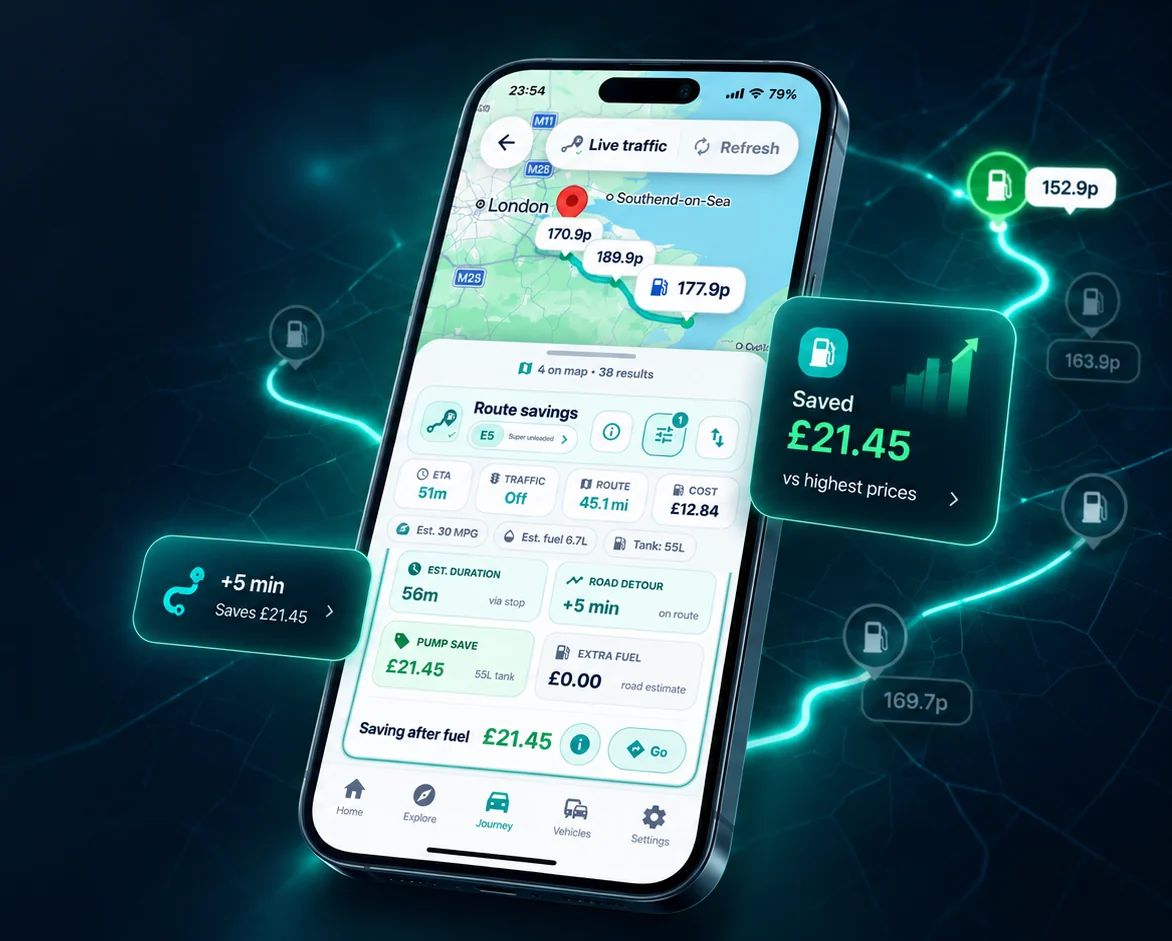
Compare E10 and E5 as separate fuel choices. Once you know the correct grade, use the web route planner to compare estimated detour fuel costs and the saving left.
No. Most modern petrol cars can use E10, but some older, classic or specialist vehicles need E5. Check the vehicle manual, fuel flap label or official E10 checker.
Not necessarily. Higher octane fuel matters most when the engine is designed, tuned or mapped to use it.
For E10-compatible vehicles, mixing E5 and E10 in the same tank is generally fine. Keep following the car manufacturer’s fuel guidance.